

A Modern Definition of Luxury
Taking a moment to move away from the solution and understand the unique needs that every client almost certainly has are fundamental principles of effective consulting and “being of service”. The process of design offers clear illustrations of these principals in action. (The editor of the CEO Refresher [Rick Sidorawicz] recently had a conversation with internationally acclaimed interior designer Henry Liska and was particularly impressed with the way Henry approaches his craft and the themes that have influenced his work over many years on projects that include private homes, corporate offices, banks, restaurants and small hotels.
Henry, a native of Toronto, has been a member of the interior design industry for more than thirty-five years; his career stretches beyond Toronto to New York City, London, Paris, Shanghai, Singapore, the Caribbean Islands and Bermuda.
Henry’s principles of design are relevant to business leadership today perhaps more than ever. In his words, he describes his approach as ”deep articulate thinking” – a beautiful expression that conveys the mindfulness and magic that brings a concept to life. One need only to think of Apple Computer to appreciate how deep articulate thinking can make already innovative products appear magical and transform an entire industry.
Henry’s following two design themes can be embraced by leaders in all organizations who seek to be more relevant, profitable and sustainable:
- Consistency – through clarifying our ideas, simplifying and focusing on what really matters;
- Uniqueness – by providing a new response appropriate to each situationThe additional themes that have consistently been expressed in Henry’s unique work also resonate in today’s business landscape:
- Open and Transparent – creating a visual, engaging sense of collaboration, trust and community and inviting others to join in;
- Functional – bringing others to the ease and elegance of that magical place where design just “works”
Henry’s projects have typically been ‘high end’ and luxurious; however, as he weaves his values, themes and propositions into his work, he is redefining the very concept of “luxury” in a most innovative and relevant way. (Rick Sidorawicz)
In Henry’s Own Words
When people learn that I am an interior designer, the first question they invariably ask me is some variation of ”what look are people using now”. Seldom am I inspired to answer questions like this directly, or at least not in a way that people are expecting. Even before I began designing more than thirty years ago, following trends never really interested me. Now, don’t get me wrong, what I do can be as cutting edge and contemporary as that of any designer. But I prefer leading edge thinking to result in rooms and spaces that are unique in every sense and not just part of some trend.
To achieve original interiors, I follow a process that takes in as many facts and givens such as site dimensions, building type, location and setting as I can assemble and then combine this information with a substantial dose of inspiration (such as a set of black Wedgewood China circa 1795 or a mahogany military dressing table from the mid 18th Century for the King of the Hellenes) and even intuition. This last element – intuition – is unquestionably the most mysterious but also the most important when it comes to bringing to light the unspoken needs and concerns of my clients. Experience has taught me that there will always be issues that even the most open and forthright among those I am working with will attempt to hide and prevent from being discussed. And I need to be aware of both the spoken and unspoken if I am able to successfully create a luxury home that is suitable in every way possible.
When designing, I always start by taking my clients’ activities, hobbies and collections into account to establish a theme. What is of interest to my clients may be as particular as their equestrian lifestyle, a formidable art or wine collection or the desire to entertain on a lavish scale. Working meticulously, I create one-of-a-kind design solutions that fir my clients’ lives like a key in a lock. For instance, for a couple that often sets aside time to enjoy deep sea fishing together and maintains properties on Bermuda as well as several other Caribbean islands, I made sure that the interiors of their vacation homes were all focused on the ocean, Not just with nautical themes but directly from the standpoint of the interior architecture. For this couple’s home in the Grenadine Islands, I created a sunken bar and seating lounge that opens onto a subterranean grotto through floor to ceiling glass doors. Furnishings in this grotto are built around cylindrical sea water aquarium tanks using nautical grade materials such as stainless steel, teak and mahogany. All of the fabrics and carpets are woven with an abstract blue and blue pattern that resembles waves creating and breaking.
Another couple I work with frequently loves to showcase their talent for classic French cooking. For their Muskoka vacation home, I made sure the kitchen was front and centre in my design. “Floating” like an island on top of the massive stairway that rises and falls around their “kitchen pulpit”, my clients can be seen cutting, chopping and working the stoves from all around.
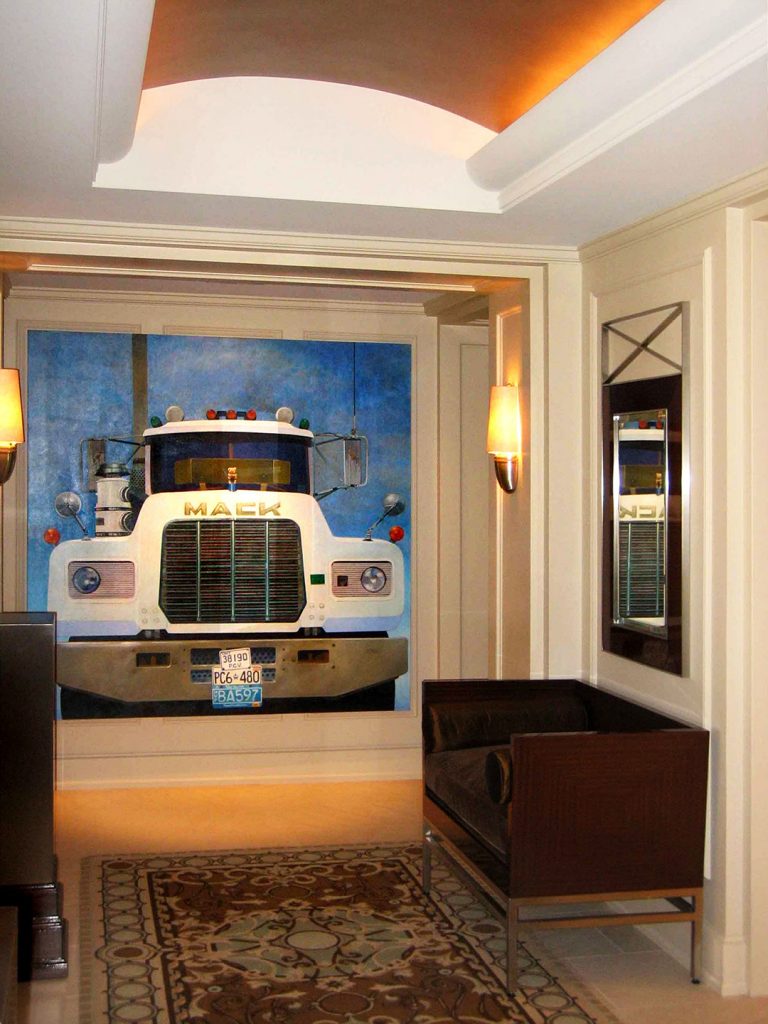
For a client who made his reputation – and fortune – in the trucking business, I had an artist paint an almost photorealistic “portrait” of a Mack Truck and hang it in the private elevator lobby of his suite at one of Toronto’s leading condominium residences. I saw this painting as my own insouciant way of relating his business (and love of trucks) to his personal life – something that differentiates his home from that of any other I have worked on before or since.
The continuing need to arrive at original solutions is what makes designing challenging – and a perennial joy that is so rewarding to someone such as myself. As long as I have clients who require original, one-of-a-kind homes that suit their specific needs and fulfill their lifestyle re- quirements, it would be impossible to exhaust my creativity and run out of ideas. I have been designing long enough to know that my creativity is grounded in both practical understanding as well as a mental catalogue of artistic precedent. Using these, I have no need to follow trends slavishly or resort to ready-made solutions.
Henry’s new definition of luxury – open, transparent functional, consistent and unique – provides design themes that leaders in every field can engage to innovate, unleash creativity, differentiate themselves and better serve their clients and constituents.
Thanks Henry. Looking forward to seeing more. (Rick Sidorawicz.)[/vc_column_text][/vc_column][/vc_row]
Leave a Comments